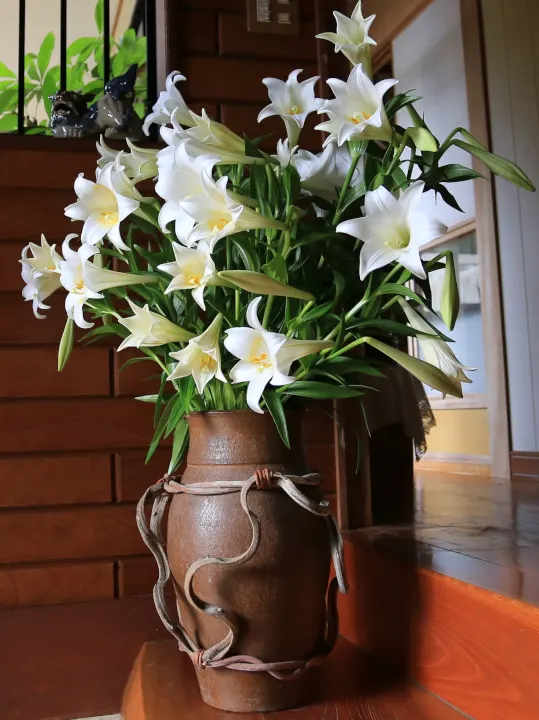
A cut-flower lily bred from Easter lilies that once grew wild on Okinoerabu Island, Kagoshima. It has pure white blossoms, a gentle fragrance and rounded leaves, and is used for New Year arrangements and spring equinox grave visits.
- Prefectures
- Kagoshima
- Production area
- Wadomari Town and China Town (Oshima County), Kagoshima Prefecture
- Season
- Dec–Apr
- Registered
- November 18, 2020(Reg. No. 102)
- Registered producer group
- Okinoerabu Agricultural Flower CooperativeAmami Agricultural Cooperative (opens in a new tab)
- Category (as registered)
- 第12類 観賞用の植物類 切花(ゆり)
Seasonal calendar
Shipments are concentrated from December to April, when few other regions supply lilies.
Timing shifts with the weather and conditions in each region.
Official registration details (MAFF)
The registered description as published by the Ministry of Agriculture, Forestry and Fisheries.
Characteristics
Propagated and bred from Lilium longiflorum found in the wild on Okinoerabu Island and other places nearby, Erabu Lily has a soft scent, pure white petals, and slightly rounded leaves. Because the scent is not overpowering, and the appearance is noble, the flower has been a popular choice for various formal ceremonies. Today, it is indispensable for New Year decorations, and for cemetery/graveside flowers during the spring higan.
Link with the production area
The warm climate of Okinoerabu Island, a raised coral atoll where the average annual temperature is about 22°C, is ideal for the production of Erabu Lily, which has an optimal growth temperature of between 15 and 20°C. Production started after a British visitor spotted wild lily habitats on the island in 1899, and suggested growing the plants in coastal fields.
Characteristics and link with the area: Ministry of Agriculture, Forestry and Fisheries website (https://www.maff.go.jp/e/policies/intel/gi_act/register/s102.html)
Where to buy
As a rule, only products that meet the registered standard may use a GI name (with exceptions such as prior use). Check for the GI mark and the place of origin to tell it apart from ordinary products with similar names.
We have not found a reliable online or furusato nozei listing yet. Ask local farm stands or the producer group.
FAQ
A cut-flower lily bred from Easter lilies that once grew wild on Okinoerabu Island, Kagoshima. It has pure white blossoms, a gentle fragrance and rounded leaves, and is used for New Year arrangements and spring equinox grave visits.
Erabu Lily is produced in Wadomari Town and China Town (Oshima County), Kagoshima Prefecture.
Erabu Lily is in season (harvested or shipped) in Dec–Apr. Shipments are concentrated from December to April, when few other regions supply lilies.
We have not confirmed a reliable online or furusato nozei listing. Local farm stands or the producer group are your best bet.
Erabu Lily was registered as a Geographical Indication on November 18, 2020 (Registration No. 102). The registered producer group is Okinoerabu Agricultural Flower CooperativeAmami Agricultural Cooperative.
More GIs from Kagoshima
More Crafts & flowers GIs
More from Kagoshima
Discover the protected animals, festivals, paintings and sights of the same region.
Meiga no Furusato
Paintings linked to Kagoshima
- Famous Places in the Sixty-odd Provinces: Osumi Province: Sakurajima
- Famous Places in the Sixty-odd Provinces: Satsuma Province: The Twin-Sword Rocks at Bonoura
Sake Tabi
Breweries and distilleries in Kagoshima
- Satsuma Shuzo Meijigura (Kedogawa Distillery)
- Amami Beer Hall (Amami Beer)
- Catch the Beer (Kosegawa Brewery)
- Hamada Shuzo Denbeegura
Official information
- MAFF registration page (Japanese) (opens in a new tab)
- MAFF product summary (English) (opens in a new tab)
- Registered product panel (PDF) (opens in a new tab)
This page is produced by Matatabi Inc. It is not created or endorsed by the Ministry of Agriculture, Forestry and Fisheries.