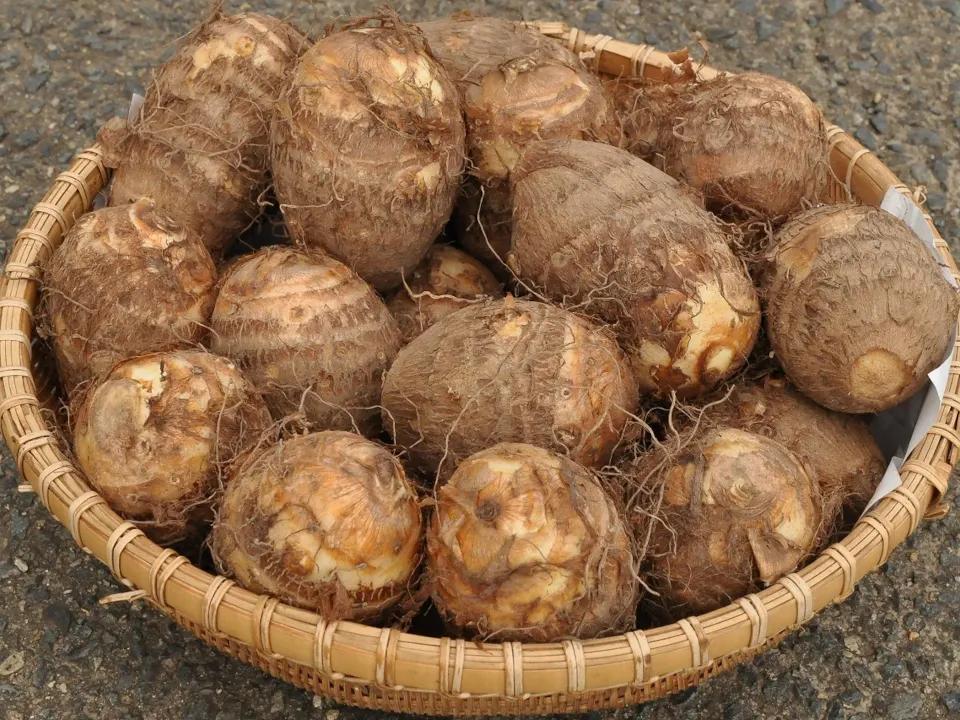
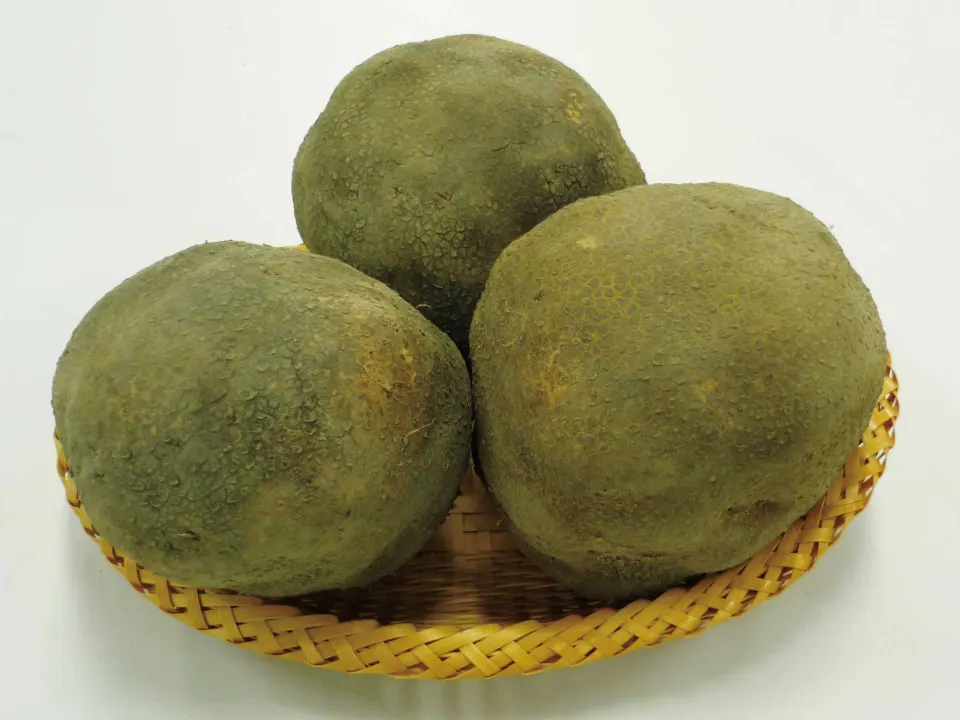
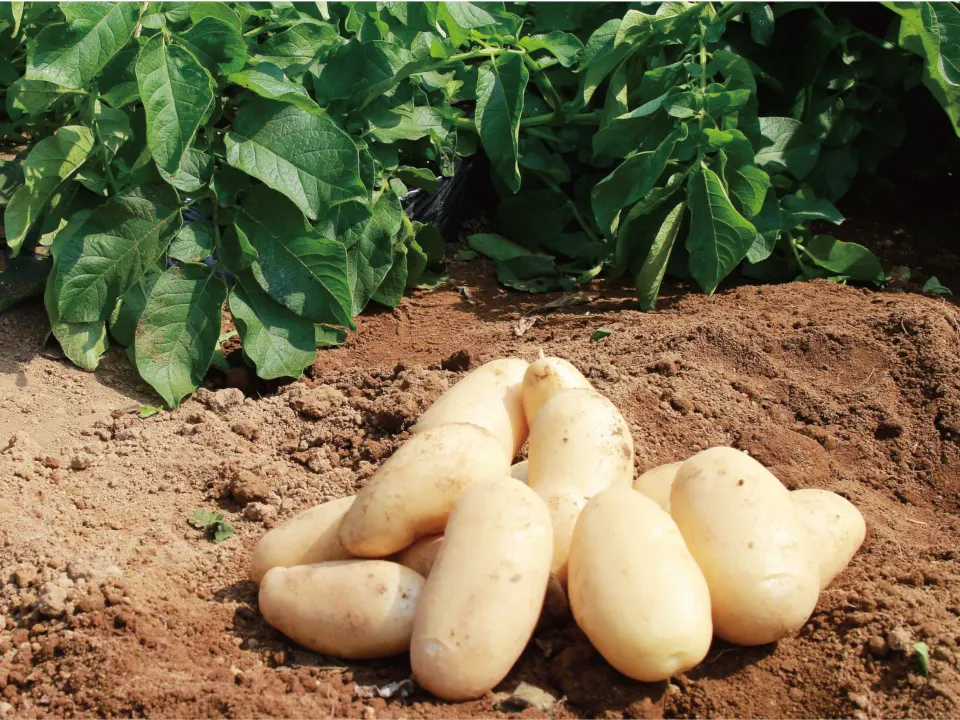
Taro passed down in Kitakami City, Iwate Prefecture. The corms are large and uniform, with a rich flavor and smooth texture; soft yet strongly sticky, they hold their shape when simmered. Seed tubers are hard to store, so growers have long shared them with one another to keep the line alive.
- Prefectures
- Iwate
- Production area
- Kitakami City, Iwate Prefecture
- Season
- Sep–Nov
- Registered
- September 27, 2018(Reg. No. 68)
- Registered producer group
- Futago Satoimo Association
- Category (as registered)
- 第2類 野菜類 さといも
Seasonal calendar
Shipping begins in early September each year, and the taro is available through the autumn.
Timing shifts with the weather and conditions in each region.
Official registration details (MAFF)
The registered description as published by the Ministry of Agriculture, Forestry and Fisheries.
Characteristics
Futago Satoimo has rich taste and smooth texture. Although the flesh is soft, the shape is maintained even if it is stewed due to its strong stickiness. Futago Satoimo is relatirely large and of uniform size.
Link with the production area
Since the production area formed by flooding of the Kitakami River has well-drained and fertile soil and the cultivated soil is also deep, the area is suitable for the production of taro. Producers have inherited a storage technique for the seed tuber, which is difficult to store. Also, producers have established a custom to provide the seed tuber among them since long ago in case of failure to store the seed tuber. Thus, the production area has preserved the seed tuber as well as the technique from generation to generation.
Characteristics and link with the area: Ministry of Agriculture, Forestry and Fisheries website (https://www.maff.go.jp/e/policies/intel/gi_act/register/s68.html)
Where to buy
As a rule, only products that meet the registered standard may use a GI name (with exceptions such as prior use). Check for the GI mark and the place of origin to tell it apart from ordinary products with similar names.
These links go to Japanese-language shops; check whether they ship overseas.
Some shop links on this page are affiliate links; we may earn a commission at no extra cost to you.
FAQ
Taro passed down in Kitakami City, Iwate Prefecture. The corms are large and uniform, with a rich flavor and smooth texture; soft yet strongly sticky, they hold their shape when simmered. Seed tubers are hard to store, so growers have long shared them with one another to keep the line alive.
Futago Taro is produced in Kitakami City, Iwate Prefecture.
Futago Taro is in season (harvested or shipped) in Sep–Nov. Shipping begins in early September each year, and the taro is available through the autumn.
Look for it via furusato nozei (hometown tax donation) and online shops. Check the GI mark and the place of origin before you buy.
Futago Taro was registered as a Geographical Indication on September 27, 2018 (Registration No. 68). The registered producer group is Futago Satoimo Association.
More GIs from Iwate
More Vegetables GIs
More from Iwate
Discover the protected animals, festivals, paintings and sights of the same region.
Meiga no Furusato
Paintings linked to Iwate
- The Golden Hall, Hiraizumi
- Self-Portrait with Red Eyes
- Self-Portrait in Pointillist Style
- Near Yurakucho Station
Sake Tabi
Breweries and distilleries in Iwate
- Asabiraki Brewery Tour and Local Sake Shop
- Baeren Brewery (Kitayama Plant)
- Edelwein Winery Factory Tour (Wine Chateau Osako)
- Iwate Kuzumaki Wine Factory Tour
Official information
- MAFF registration page (Japanese) (opens in a new tab)
- MAFF product summary (English) (opens in a new tab)
- Registered product panel (PDF) (opens in a new tab)
This page is produced by Matatabi Inc. It is not created or endorsed by the Ministry of Agriculture, Forestry and Fisheries.