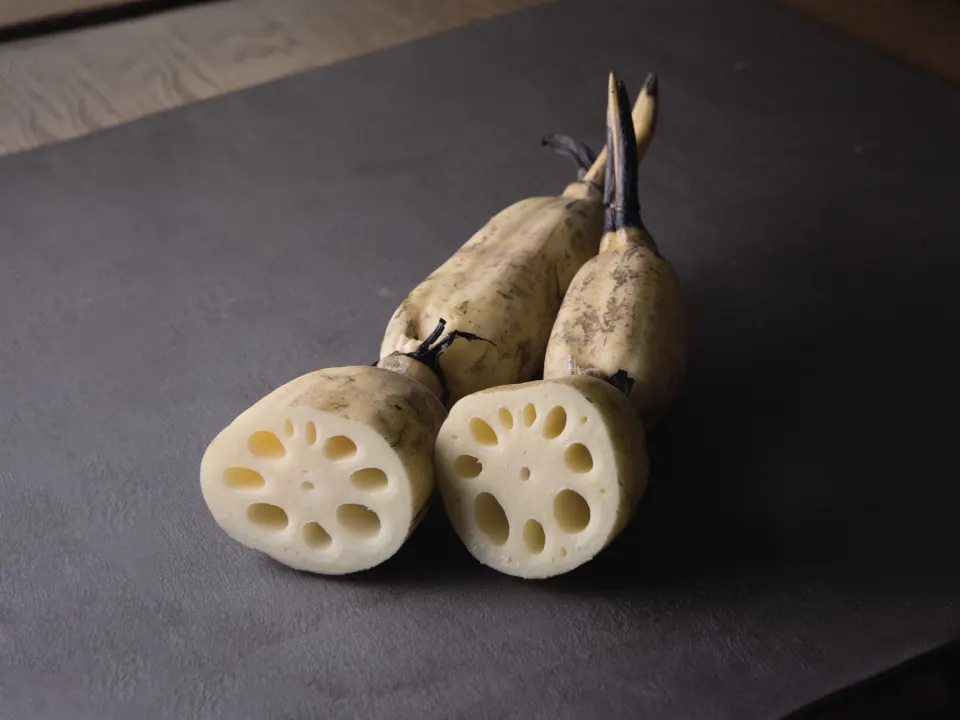
Lotus root grown around the former village of Okuchi in Nakanoshima, Nagaoka City, Niigata, using relatively warm groundwater. Strict shipping standards ensure, for example, that no mud gets into the holes, and it is valued for its white flesh, crisp texture, sweetness and savory flavor.
- Prefectures
- Niigata
- Production area
- Okuchi Village, Ikenoshima Village, Oshikirishinden, Omoigawashinden, Omagato Village, Omagatoshinden, Haijimashinden, Nakagoya and Tsubone Village in Minamikambara County as of March 31, 1889 (now the Nakanoshima Kamidori District of Nagaoka City), Niigata Prefecture
- Season
- Aug–May
- Registered
- May 31, 2021(Reg. No. 109)
- Registered producer group
- Okuchi Renkon Producers Association
- Category (as registered)
- 第1類 農産物類 野菜類(れんこん)
Seasonal calendar
Available from late August through about May of the following year.
Timing shifts with the weather and conditions in each region.
Official registration details (MAFF)
The registered description as published by the Ministry of Agriculture, Forestry and Fisheries.
Characteristics
Okuchi Renkon lotus roots are shipped injury-free and with mud-free holes, thanks to the stringent quality standards in place. This means their white flesh cooks with less chance of discoloring into dark purple hues.Okuchi Renkon lotus roots are rated highly for the whiteness of their flesh, crunchiness, sweetness, umami, and flavor, increasingly attracting orders asking for this specific production location.
Link with the production area
Renkon growth requires high temperatures, and so the widely accepted northern limit of commercially viable production has been Ibaraki and Tochigi Prefectures. Okuchi Renkon production in Niigata Prefecture further up north is an exception to this rule because it makes use of local groundwater, which is warmer than in parts of Niigata City. The high groundwater temperature has led to gas field and hot spring developments in the past.
Characteristics and link with the area: Ministry of Agriculture, Forestry and Fisheries website (https://www.maff.go.jp/e/policies/intel/gi_act/register/s109.html)
Where to buy
As a rule, only products that meet the registered standard may use a GI name (with exceptions such as prior use). Check for the GI mark and the place of origin to tell it apart from ordinary products with similar names.
These links go to Japanese-language shops; check whether they ship overseas.
Some shop links on this page are affiliate links; we may earn a commission at no extra cost to you.
It is also offered as a Nagaoka City furusato nozei (hometown tax donation) gift.
FAQ
Lotus root grown around the former village of Okuchi in Nakanoshima, Nagaoka City, Niigata, using relatively warm groundwater. Strict shipping standards ensure, for example, that no mud gets into the holes, and it is valued for its white flesh, crisp texture, sweetness and savory flavor.
Okuchi Lotus Root is produced in Okuchi Village, Ikenoshima Village, Oshikirishinden, Omoigawashinden, Omagato Village, Omagatoshinden, Haijimashinden, Nakagoya and Tsubone Village in Minamikambara County as of March 31, 1889 (now the Nakanoshima Kamidori District of Nagaoka City), Niigata Prefecture.
Okuchi Lotus Root is in season (harvested or shipped) in Aug–May. Available from late August through about May of the following year.
Look for it via furusato nozei (hometown tax donation) and online shops. Check the GI mark and the place of origin before you buy.
Okuchi Lotus Root was registered as a Geographical Indication on May 31, 2021 (Registration No. 109). The registered producer group is Okuchi Renkon Producers Association.
More GIs from Niigata

More Vegetables GIs
More from Niigata
Discover the protected animals, festivals, paintings and sights of the same region.
Meiga no Furusato
Paintings linked to Niigata
- Famous Places in the Sixty-odd Provinces: Echigo Province: Oyashirazu
- Famous Places in the Sixty-odd Provinces: Sado Province: Gold Mines
Sake Tabi
Breweries and distilleries in Niigata
- Asahi Shuzo
- Cave d'Occi Winery
- Hakkaisan Brewery (Daini Kowa Kura & Snow Cellar)
- Kaganoi Shuzo Brewery Tour
Official information
- MAFF registration page (Japanese) (opens in a new tab)
- MAFF product summary (English) (opens in a new tab)
- Registered product panel (PDF) (opens in a new tab)
This page is produced by Matatabi Inc. It is not created or endorsed by the Ministry of Agriculture, Forestry and Fisheries.