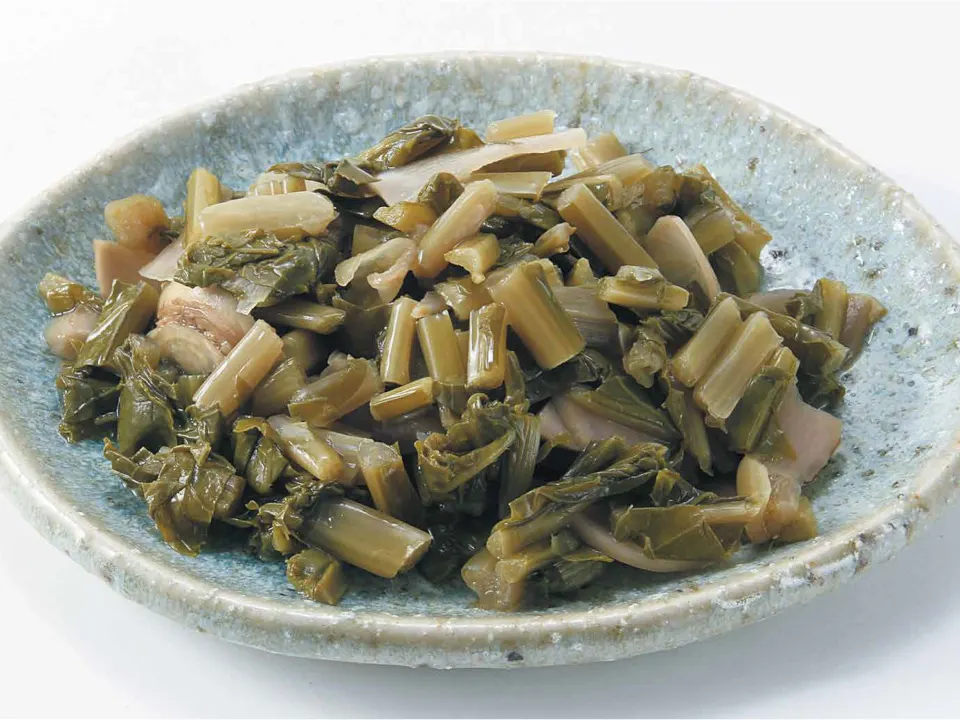
Sunki is a pickle made in the Kiso area of Nagano Prefecture by lactic-acid fermenting the stems and leaves of the local red turnip without any salt. Rare in Japan and abroad, this salt-free pickle is amber in color with a lactic tang, and it has been a Kiso tradition for more than 300 years.
- Prefectures
- Nagano
- Production area
- Former Kiso District area, Nagano Prefecture (Kiso Town, Agematsu Town, Nagiso Town, Kiso Village, Otaki Village and Okuwa Village in Kiso District, and part of Shiojiri City (former Narakawa Village))
- Season
- Dec–Mar
- Registered
- May 26, 2017(Reg. No. 34)
- Registered producer group
- Sunki Brand Promotion Association
- Category (as registered)
- 第17類 野菜加工品類 野菜漬物のうち、(一)から(八)までに掲げるもの以外の野菜漬物(乳酸発酵漬物(無塩))
Seasonal calendar
Made from late autumn to early winter and served at local restaurants and elsewhere in winter, roughly December to March.
Timing shifts with the weather and conditions in each region.
Official registration details (MAFF)
The registered description as published by the Ministry of Agriculture, Forestry and Fisheries.
Characteristics
Sunki is a pickle using leaves and stems of Kiso’s heirloom red turnips. It has tortoise shell color and has distinctive sourness. Sunki is lactic fermented product without using any salt. It is therefore very rare preserved food.
Link with the production area
Sunki has been produced for more than 300 years in the Kiso area. The high altitude and severe cold climate of the area is suitable for red turnip production. The method of not using salt was developed in old times when salt was very valuable in the mountainous area of Kiso during winter.
Characteristics and link with the area: Ministry of Agriculture, Forestry and Fisheries website (https://www.maff.go.jp/e/policies/intel/gi_act/register/s34.html)
Where to buy
As a rule, only products that meet the registered standard may use a GI name (with exceptions such as prior use). Check for the GI mark and the place of origin to tell it apart from ordinary products with similar names.
These links go to Japanese-language shops; check whether they ship overseas.
Some shop links on this page are affiliate links; we may earn a commission at no extra cost to you.
FAQ
Sunki is a pickle made in the Kiso area of Nagano Prefecture by lactic-acid fermenting the stems and leaves of the local red turnip without any salt. Rare in Japan and abroad, this salt-free pickle is amber in color with a lactic tang, and it has been a Kiso tradition for more than 300 years.
Sunki Pickles is produced in Former Kiso District area, Nagano Prefecture (Kiso Town, Agematsu Town, Nagiso Town, Kiso Village, Otaki Village and Okuwa Village in Kiso District, and part of Shiojiri City (former Narakawa Village)).
Sunki Pickles is in season (harvested or shipped) in Dec–Mar. Made from late autumn to early winter and served at local restaurants and elsewhere in winter, roughly December to March.
Look for it via furusato nozei (hometown tax donation) and online shops. Check the GI mark and the place of origin before you buy.
Sunki Pickles was registered as a Geographical Indication on May 26, 2017 (Registration No. 34). The registered producer group is Sunki Brand Promotion Association.
More GIs from Nagano
More Processed foods GIs
More from Nagano
Discover the protected animals, festivals, paintings and sights of the same region.
Meiga no Furusato
Paintings linked to Nagano
- Thirty-six Views of Mount Fuji: Lake Suwa in Shinano Province
- The Sixty-nine Stations of the Kisokaido: Karuizawa
- The Sixty-nine Stations of the Kisokaido: Rain on the Hiratsuka Plain near Kutsukake Station
- The Sixty-nine Stations of the Kisokaido: View of Mount Asama from Oiwake Station
Sake Tabi
Breweries and distilleries in Nagano
- Chateau Mercian Kikyogahara Winery
- Hayashi Farm Goichi Wine Vineyard Visit
- Mars Komagatake Distillery (Hombo Shuzo)
- Yomeishu Museum Komagane (Yomeishu Seizo Komagane Plant)
Official information
- MAFF registration page (Japanese) (opens in a new tab)
- MAFF product summary (English) (opens in a new tab)
- Registered product panel (PDF) (opens in a new tab)
This page is produced by Matatabi Inc. It is not created or endorsed by the Ministry of Agriculture, Forestry and Fisheries.