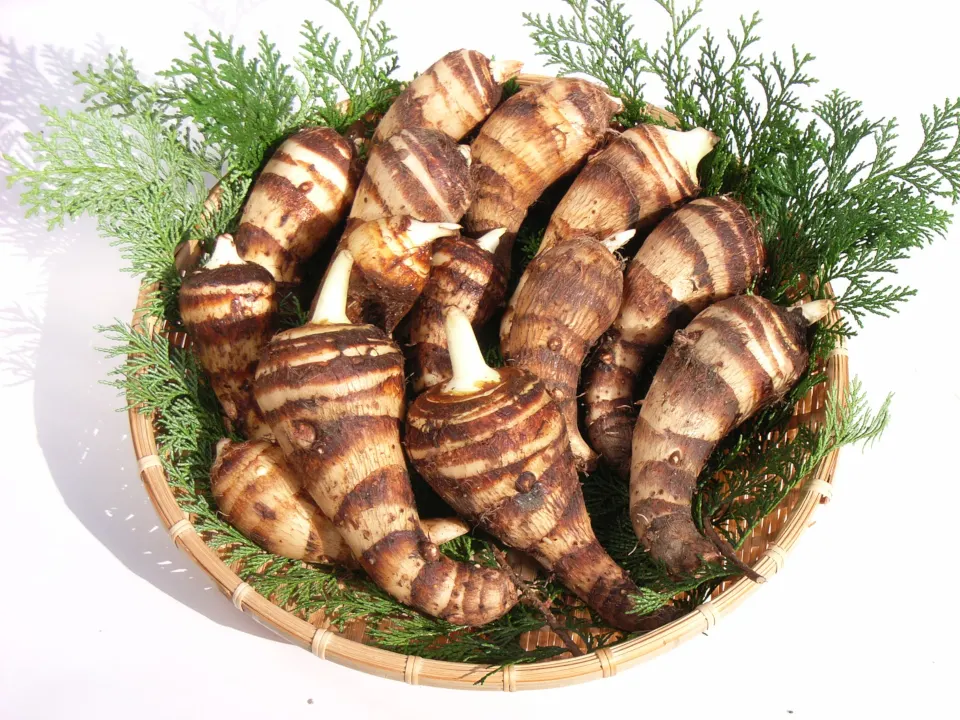
A taro selected and developed from a local variety in Tondabayashi, Osaka. Its name comes from its curved, striped, shrimp-like shape. Prized for its fluffy yet smooth texture, it is valued by traditional Japanese restaurants in Kyoto and Tokyo.
- Prefectures
- Osaka
- Production area
- Tondabayashi City, Osaka Prefecture (Ochikata, Nishi-Itamochi, Higashi-Itamochi, Minami-Otomo, Kita-Otomo, Nishikiori)
- Season
- Nov–Jan
- Registered
- July 20, 2023(Reg. No. 137)
- Registered producer group
- Tondabayashi City Ebiimo Promotion Council
- Category (as registered)
- 第1類 農産物類 野菜類(さといも)
Seasonal calendar
It is shipped from around November through January.
Timing shifts with the weather and conditions in each region.
Official registration details (MAFF)
The registered description as published by the Ministry of Agriculture, Forestry and Fisheries.
Characteristics
Tondabayashi-no-Ebiimo is characterized by its curved shape and stripes like shrimp, which is said to be the origin of its name.The dry ratio of Tondabayashi-no-Ebiimo, which is an indicator of the softness and flakiness as a taste, is higher than other taros. It is a luxury foodstuff because of its smooth texture and is sold at a higher price than regular taros, and it is highly valued by Japanese-style restaurants in Kyoto and Tokyo.
Link with the production area
Tondabayashi-no-Ebiimo is a taro that has been selected and raised from a local variety cultivated mainly in the Nishiitamochi area, Tondabayashi City, Osaka Prefecture.The production area was once a paddy field area, and waterways have developed. In addition, the soil is well drained, with paddy soil deposited on sand and gravel formed by the flooding of the Ishikawa River. It is suitable for growing ebiimo, which require large amounts of water for growth but are quickly damaged by poor drainage.The field ridge technology to make taros bend like shrimps has been passed down in the region.
Characteristics and link with the area: Ministry of Agriculture, Forestry and Fisheries website (https://www.maff.go.jp/e/policies/intel/gi_act/register/s137.html)
Where to buy
As a rule, only products that meet the registered standard may use a GI name (with exceptions such as prior use). Check for the GI mark and the place of origin to tell it apart from ordinary products with similar names.
These links go to Japanese-language shops; check whether they ship overseas.
Some shop links on this page are affiliate links; we may earn a commission at no extra cost to you.
FAQ
A taro selected and developed from a local variety in Tondabayashi, Osaka. Its name comes from its curved, striped, shrimp-like shape. Prized for its fluffy yet smooth texture, it is valued by traditional Japanese restaurants in Kyoto and Tokyo.
Tondabayashi Ebiimo (Shrimp-Shaped Taro) is produced in Tondabayashi City, Osaka Prefecture (Ochikata, Nishi-Itamochi, Higashi-Itamochi, Minami-Otomo, Kita-Otomo, Nishikiori).
Tondabayashi Ebiimo (Shrimp-Shaped Taro) is in season (harvested or shipped) in Nov–Jan. It is shipped from around November through January.
Look for it via furusato nozei (hometown tax donation). Check the GI mark and the place of origin before you buy.
Tondabayashi Ebiimo (Shrimp-Shaped Taro) was registered as a Geographical Indication on July 20, 2023 (Registration No. 137). The registered producer group is Tondabayashi City Ebiimo Promotion Council.
More GIs from Osaka
More Vegetables GIs
More from Osaka
Discover the protected animals, festivals, paintings and sights of the same region.
Meiga no Furusato
Paintings linked to Osaka
- Famous Places in the Sixty-odd Provinces: Kawachi Province: Otokoyama from Hirakata
- Famous Places in the Sixty-odd Provinces: Izumi Province: Takashi Beach
- Famous Places in the Sixty-odd Provinces: Settsu Province: Idemi Beach at Sumiyoshi
Sake Tabi
Breweries and distilleries in Osaka
- Katashimo Winery
- Naniwa Shuzo (Naniwa Masamune) Brewery Tour
- Suntory Yamazaki Distillery
- Banri no Haru Brewery Beer Hall
Official information
- MAFF registration page (Japanese) (opens in a new tab)
- MAFF product summary (English) (opens in a new tab)
- Registered product panel (PDF) (opens in a new tab)
This page is produced by Matatabi Inc. It is not created or endorsed by the Ministry of Agriculture, Forestry and Fisheries.