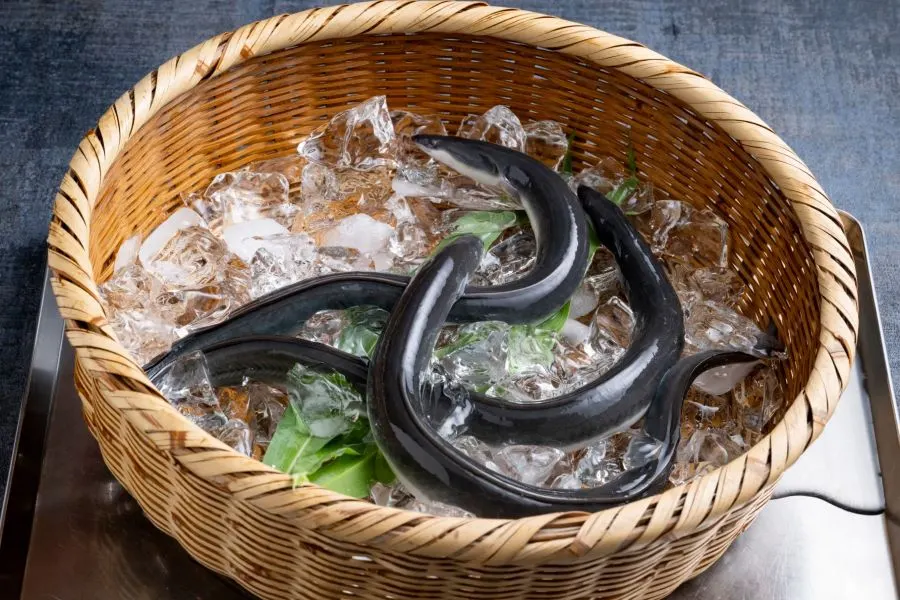
Farmed eel raised around Lake Hamanako in Shizuoka, known as the birthplace of eel farming. It is valued for its rich fat and soft, plump texture, and a distinctive food culture has grown up around it, including bokumeshi, a staff meal of eel farmers that became a local dish.
- Prefectures
- Shizuoka
- Production area
- Hamamatsu City and Kosai City, Shizuoka Prefecture
- Season
- Year-round
- Registered
- July 10, 2026(Reg. No. 177)
- Registered producer group
- Lake Hamanako Aquaculture Fisheries Cooperative (opens in a new tab)
- Category (as registered)
- 第4類 水産物類
Seasonal calendar
As a farmed product, it is available year-round.
Timing shifts with the weather and conditions in each region.
Official registration details (MAFF)
The registered description as published by the Ministry of Agriculture, Forestry and Fisheries.
Characteristics
Lake Hamanako Unagi is valued for its high fat content and tender, plump texture, among other qualities. It commands higher prices than ordinary eel and is widely known throughout Japan, to the extent that Lake Hamanako is synonymous with eel. It is also popular among tourists. The area was among the first in Japan to develop as a center of eel farming, and a distinctive food culture has taken root, as exemplified by bokumeshi, originally a staff meal for eel farmers that evolved into a local dish. Lake Hamanako Unagi plays an important role in a wide range of areas, including history, culture, the economy, and tourism.
Link with the production area
The production area offers a natural environment ideally suited to eel farming. Glass eels were abundant around Lake Hamanako, which has brackish waters, and the area has a mild climate with high water temperatures, as well as access to groundwater and other water sources with stable water quality. The area succeeded in farming eels between 1897 and 1906. In 1971, it established a heated-water eel-farming method, which resulted in faster growth and a reduction in disease incidence. The area developed into a major center of eel farming and is recognized as the “birthplace of eel farming.”
Characteristics and link with the area: Ministry of Agriculture, Forestry and Fisheries website (https://www.maff.go.jp/e/policies/intel/gi_act/register/s177.html)
Where to buy
As a rule, only products that meet the registered standard may use a GI name (with exceptions such as prior use). Check for the GI mark and the place of origin to tell it apart from ordinary products with similar names.
These links go to Japanese-language shops; check whether they ship overseas.
Some shop links on this page are affiliate links; we may earn a commission at no extra cost to you.
FAQ
Farmed eel raised around Lake Hamanako in Shizuoka, known as the birthplace of eel farming. It is valued for its rich fat and soft, plump texture, and a distinctive food culture has grown up around it, including bokumeshi, a staff meal of eel farmers that became a local dish.
Lake Hamanako Eel is produced in Hamamatsu City and Kosai City, Shizuoka Prefecture.
Lake Hamanako Eel is shipped all year round. As a farmed product, it is available year-round.
Look for it via furusato nozei (hometown tax donation), online shops and the producer group's own shop. Check the GI mark and the place of origin before you buy.
Lake Hamanako Eel was registered as a Geographical Indication on July 10, 2026 (Registration No. 177). The registered producer group is Lake Hamanako Aquaculture Fisheries Cooperative.
More GIs from Shizuoka
More Seafood GIs
More from Shizuoka
Discover the protected animals, festivals, paintings and sights of the same region.
Meiga no Furusato
Paintings linked to Shizuoka
- Thirty-six Views of Mount Fuji: Fine Wind, Clear Morning (Red Fuji)
- Thirty-six Views of Mount Fuji: Thunderstorm Beneath the Summit
- Thirty-six Views of Mount Fuji: Mishima Pass in Kai Province
- Thirty-six Views of Mount Fuji: Ejiri in Suruga Province
Sake Tabi
Breweries and distilleries in Shizuoka
- Fuji Takasago Sake Brewery
- Hananomai Brewing
- Kirin Fuji Gotemba Distillery
- Nakaizu Winery Hills (Chateau T.S)
Official information
- MAFF registration page (Japanese) (opens in a new tab)
- MAFF product summary (English) (opens in a new tab)
- Registered product panel (PDF) (opens in a new tab)
This page is produced by Matatabi Inc. It is not created or endorsed by the Ministry of Agriculture, Forestry and Fisheries.