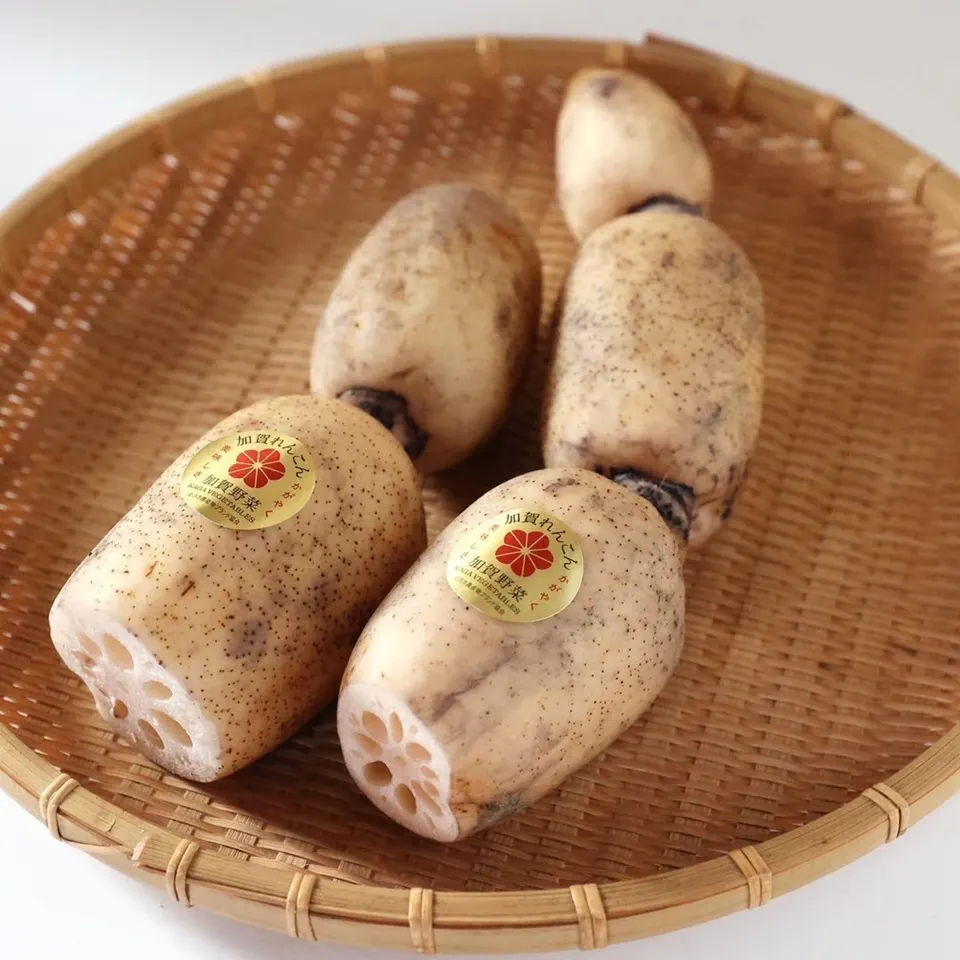
A lotus root grown in Kanazawa and on the Kahokugata reclaimed land in Ishikawa, and one of the traditional Kaga vegetables. Thick-fleshed and starchy, it is so sticky that, when grated, it forms dumplings without a binder. It is crisp in summer and pleasantly chewy in winter.
- Prefectures
- Ishikawa
- Production area
- Kanazawa City and the Kahokugata Reclaimed Land, Ishikawa Prefecture
- Season
- Aug–May
- Registered
- July 10, 2026(Reg. No. 178)
- Registered producer group
- JA Kanazawa City Kaga Renkon Producers’ Group
- Category (as registered)
- 第1類 農産物類
Seasonal calendar
It is shipped from early August to late May of the following year, peaking in November; it is crisp in summer and turns chewy from October on.
Timing shifts with the weather and conditions in each region.
Official registration details (MAFF)
The registered description as published by the Ministry of Agriculture, Forestry and Fisheries.
Characteristics
Kaga Renkon has thick flesh and a high starch content. When grated, it is so sticky that it forms a dumpling-like mass without a binding agent. Its stickiness increases further from autumn through winter, so it has a crisp texture in summer and a chewy texture in winter. It has become an essential ingredient in local dishes such as hasu-mushi and surinagashi-jiru. In addition to its excellent eating quality, Kaga Renkon exhibits considerable sabi, or darkening of the skin, which is regarded as an indication of freshness. Its long shelf life and stable supply system are also highly regarded by market professionals, and it commands higher prices than ordinary lotus root.
Link with the production area
The production area receives abundant rainfall and has extensive areas of heavy clay soil in which a person’s feet can become so deeply stuck that they cannot be pulled free once they step into a field. These conditions are suitable for cultivating lotus root, which requires large amounts of water and soil with high water-retention capacity. Kaga Renkon is said to have originated approximately 300 years ago, when Tsunanori Maeda, lord of the Kaga Domain, brought seedlings back from Mino during an alternate-attendance journey and planted them within Kanazawa Castle. Developed through many years of improvement, Kaga Renkon is one of the Kaga vegetables. It is eaten as an auspicious food and is deeply rooted in the region’s food culture.
Characteristics and link with the area: Ministry of Agriculture, Forestry and Fisheries website (https://www.maff.go.jp/e/policies/intel/gi_act/register/s178.html)
Where to buy
As a rule, only products that meet the registered standard may use a GI name (with exceptions such as prior use). Check for the GI mark and the place of origin to tell it apart from ordinary products with similar names.
These links go to Japanese-language shops; check whether they ship overseas.
Some shop links on this page are affiliate links; we may earn a commission at no extra cost to you.
FAQ
A lotus root grown in Kanazawa and on the Kahokugata reclaimed land in Ishikawa, and one of the traditional Kaga vegetables. Thick-fleshed and starchy, it is so sticky that, when grated, it forms dumplings without a binder. It is crisp in summer and pleasantly chewy in winter.
Kaga Lotus Root is produced in Kanazawa City and the Kahokugata Reclaimed Land, Ishikawa Prefecture.
Kaga Lotus Root is in season (harvested or shipped) in Aug–May. It is shipped from early August to late May of the following year, peaking in November; it is crisp in summer and turns chewy from October on.
Look for it via furusato nozei (hometown tax donation) and online shops. Check the GI mark and the place of origin before you buy.
Kaga Lotus Root was registered as a Geographical Indication on July 10, 2026 (Registration No. 178). The registered producer group is JA Kanazawa City Kaga Renkon Producers’ Group.
More GIs from Ishikawa
More Vegetables GIs
More from Ishikawa
Discover the protected animals, festivals, paintings and sights of the same region.
Ikimono Kokuho
Natural Monument animals of Ishikawa
- Bean Goose (including Taiga and Tundra Bean Geese)
- Greater White-fronted Goose
- Hokuriku Salamander
- Anchor-marked Tiger Beetle
Meiga no Furusato
Paintings linked to Ishikawa
- Famous Places in the Sixty-odd Provinces: Kaga Province: Fishing Fires on Lake Renko, One of the Eight Views of Kanazawa
- Famous Places in the Sixty-odd Provinces: Noto Province: Bay of Waterfalls
Sake Tabi
Breweries and distilleries in Ishikawa
- Fukumitsuya (Kanazawa Brewery Tour)
- BREW CLASSIC Taproom
- Heart & Beer Nihonkai Club (Okunoto Beer)
- KOMATSU BREWING
Official information
- MAFF registration page (Japanese) (opens in a new tab)
- MAFF product summary (English) (opens in a new tab)
- Registered product panel (PDF) (opens in a new tab)
This page is produced by Matatabi Inc. It is not created or endorsed by the Ministry of Agriculture, Forestry and Fisheries.