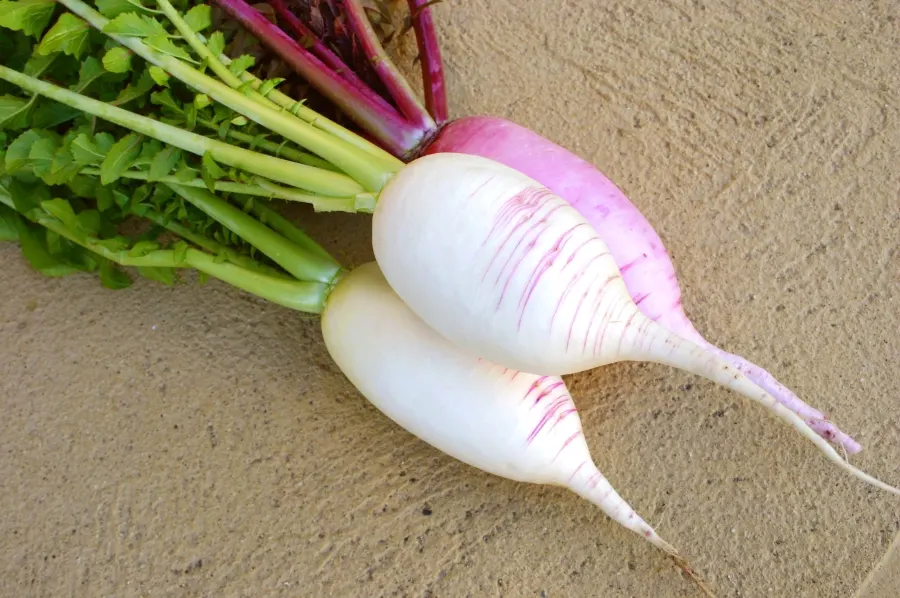
A native daikon radish long grown and passed down in Nishimera, Miyazaki. Short, thick, and spindle-shaped, it has reddish-purple horizontal stripes on its skin that look like wound thread. The dense flesh holds its shape when cooked, is tender like a turnip, and is sweeter than common aokubi daikon.
- Prefectures
- Miyazaki
- Production area
- Nishimera Village, Koyu District, Miyazaki Prefecture
- Season
- Season not confirmed
- Registered
- March 25, 2026(Reg. No. 173)
- Registered producer group
- Mera Itomaki Daikon Association
- Category (as registered)
- 第1類 農産物類
Official registration details (MAFF)
The registered description as published by the Ministry of Agriculture, Forestry and Fisheries.
Characteristics
Mera Itomaki Daikon is a native variety of daikon that has long been cultivated and passed down through generations in Nishimera Village, Koyu District, Miyazaki Prefecture. It has a distinctive appearance, with a short, thick, spindle-shaped root whose white-based or red-based skin is marked by multiple reddish-purple transverse stripes that resemble threads wound around it. The flesh is dense and does not easily fall apart during cooking, while its texture is tender, similar to that of a turnip. It has a pronounced sweetness, with a sugar content of approximately 6 degrees, about 2 degrees higher than that of the aokubi daikon commonly available on the market.
Link with the production area
Mera Itomaki Daikon grows well with almost no fertilizer or pesticides and has been cultivated as one of the important crops suited to slash-and-burn agriculture on sloping land in hilly and mountainous areas. Although production has now shifted to permanent fields, it continues to be produced without interruption as a traditional vegetable of the region. To preserve the characteristics inherited from this native variety, including its distinctive appearance and eating quality, producers have saved their own seed using line selection and a traditional cultivation method known as suemoto.
Characteristics and link with the area: Ministry of Agriculture, Forestry and Fisheries website (https://www.maff.go.jp/e/policies/intel/gi_act/register/s173.html)
Where to buy
As a rule, only products that meet the registered standard may use a GI name (with exceptions such as prior use). Check for the GI mark and the place of origin to tell it apart from ordinary products with similar names.
These links go to Japanese-language shops; check whether they ship overseas.
Some shop links on this page are affiliate links; we may earn a commission at no extra cost to you.
Online and through furusato nozei (hometown tax donations), it is most often available as processed products such as dried daikon strips.
FAQ
A native daikon radish long grown and passed down in Nishimera, Miyazaki. Short, thick, and spindle-shaped, it has reddish-purple horizontal stripes on its skin that look like wound thread. The dense flesh holds its shape when cooked, is tender like a turnip, and is sweeter than common aokubi daikon.
Mera Itomaki Daikon (Radish) is produced in Nishimera Village, Koyu District, Miyazaki Prefecture.
Look for it via furusato nozei (hometown tax donation) and online shops. Check the GI mark and the place of origin before you buy.
Mera Itomaki Daikon (Radish) was registered as a Geographical Indication on March 25, 2026 (Registration No. 173). The registered producer group is Mera Itomaki Daikon Association.
More GIs from Miyazaki
More Vegetables GIs
More from Miyazaki
Discover the protected animals, festivals, paintings and sights of the same region.
Sake Tabi
Breweries and distilleries in Miyazaki
- Kagura Shuzo Tunnel no Eki (tunnel cask storage)
- Kirishima Factory Garden (Kirishima Shuzo)
- Aozora Ale
- B.M.B Brewery (Beer Market BASE)
Official information
- MAFF registration page (Japanese) (opens in a new tab)
- MAFF product summary (English) (opens in a new tab)
- Registered product panel (PDF) (opens in a new tab)
This page is produced by Matatabi Inc. It is not created or endorsed by the Ministry of Agriculture, Forestry and Fisheries.