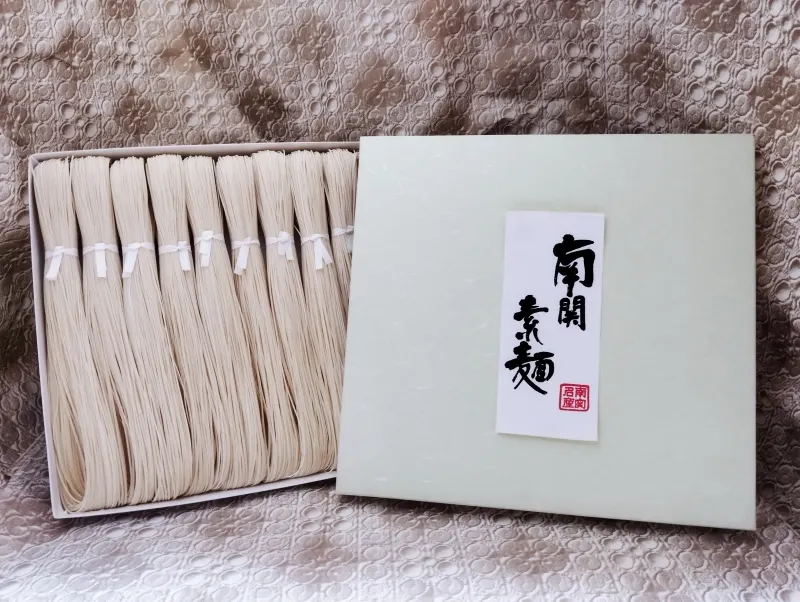
Somen noodles made in Nankan, Kumamoto, since the Edo period. They are produced entirely by hand-kneading and hand-stretching without any machinery, a rare practice even in Japan, which has earned them the nickname "the elusive somen." They are known for their smooth slurp and firm, springy texture.
- Prefectures
- Kumamoto
- Production area
- Nankan Town, Tamana District, Kumamoto Prefecture
- Season
- Season not confirmed
- Registered
- March 25, 2026(Reg. No. 174)
- Registered producer group
- Nankanmachi Seki Somen Manufacturing Association
- Category (as registered)
- 第5類 農産加工品類
Seasonal calendar
As a processed product, it is available year-round; noodle making peaks in the cold months of January to March.
Timing shifts with the weather and conditions in each region.
Official registration details (MAFF)
The registered description as published by the Ministry of Agriculture, Forestry and Fisheries.
Characteristics
Nankan Somen has a history of production dating back to the Edo period. It is made using the traditional methods of hand-kneading and hand-stretching, without the use of any machinery, a practice that is rare even in Japan. Because of its rarity, it has earned the nickname “the elusive somen.” Its smoothness when swallowed and its distinctly firm, resilient texture are highly regarded by consumers. Despite its limited production volume, it is so highly prized that producers receive numerous orders from across Japan.
Link with the production area
The production area lies in a basin surrounded by mountains. Its low winter temperatures and dry air provide climatic conditions suitable for making somen. High-quality wheat, salt, and other ingredients have long been produced in the surrounding area, making it easy to procure the principal ingredients for somen. Consequently, farmers have produced somen as a secondary occupation during the winter. Performing the entire production process by hand, without the use of any machinery, gives Nankan Somen its distinctive texture, and producers have steadfastly preserved this traditional production method over many years.
Characteristics and link with the area: Ministry of Agriculture, Forestry and Fisheries website (https://www.maff.go.jp/e/policies/intel/gi_act/register/s174.html)
Where to buy
As a rule, only products that meet the registered standard may use a GI name (with exceptions such as prior use). Check for the GI mark and the place of origin to tell it apart from ordinary products with similar names.
These links go to Japanese-language shops; check whether they ship overseas.
Some shop links on this page are affiliate links; we may earn a commission at no extra cost to you.
FAQ
Somen noodles made in Nankan, Kumamoto, since the Edo period. They are produced entirely by hand-kneading and hand-stretching without any machinery, a rare practice even in Japan, which has earned them the nickname "the elusive somen." They are known for their smooth slurp and firm, springy texture.
Nankan Somen (Hand-Stretched Noodles) is produced in Nankan Town, Tamana District, Kumamoto Prefecture.
Look for it via online shops. Check the GI mark and the place of origin before you buy.
Nankan Somen (Hand-Stretched Noodles) was registered as a Geographical Indication on March 25, 2026 (Registration No. 174). The registered producer group is Nankanmachi Seki Somen Manufacturing Association.
More GIs from Kumamoto
More Processed foods GIs
More from Kumamoto
Discover the protected animals, festivals, paintings and sights of the same region.
Ikimono Kokuho
Natural Monument animals of Kumamoto
- Moore's Cupid (Goishi-tsubame-shijimi)
- Tortoiseshell Salamander
- Kurekodori (Kureko chicken)
- Amami Whipscorpion
Meiga no Furusato
Paintings linked to Kumamoto
- Famous Places in the Sixty-odd Provinces: Chikugo Province: Fish Weirs in the Rapids
- Famous Places in the Sixty-odd Provinces: Higo Province: Gokanosho
Official information
- MAFF registration page (Japanese) (opens in a new tab)
- MAFF product summary (English) (opens in a new tab)
- Registered product panel (PDF) (opens in a new tab)
This page is produced by Matatabi Inc. It is not created or endorsed by the Ministry of Agriculture, Forestry and Fisheries.