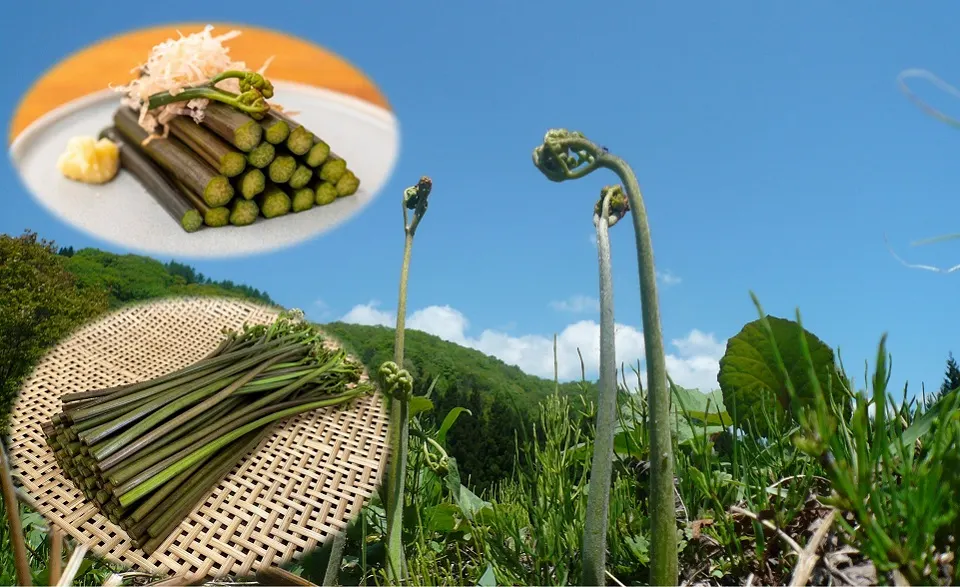
A native bracken from Nishiwaga, Iwate, registered both fresh and boiled. The shoots are thick and long, turn soft and silky when boiled, and are rich in umami with very little bitterness or stringiness. The rhizomes are also used to make warabi mochi.
- Prefectures
- Iwate
- Production area
- Nishiwaga Town, Waga District, Iwate Prefecture
- Season
- May
- Registered
- January 29, 2024(Reg. No. 145)
- Registered producer group
- Nishiwaga Warabi Seisan Hanbai Network (Nishiwaga Warabi Production and Sales Network)
- Category (as registered)
- 第1類 農産物類 野菜類(わらび)第5類 農産加工品類 野菜加工品類(わらびの水煮)
Seasonal calendar
The harvest gets into full swing around mid-May after the snow melts; boiled bracken is sold year-round.
Timing shifts with the weather and conditions in each region.
Official registration details (MAFF)
The registered description as published by the Ministry of Agriculture, Forestry and Fisheries.
Characteristics
"Nishi Warabi" is a warabi (bracken) that is characterized by thick and long shoots. The shoots are soft when boiled and has abundant umami content, minimal astringency, and a small amount of stiff fibers. The bracken is highly valued by consumers as it is traded at a higher price than bracken from other producing areas, and is closely connected to the local food culture.The rhizome of Nishi Warabi is also used as an ingredient for "warabi mochi", a specialty of the area.
Link with the production area
Bracken plants have grown naturally in Nishiwaga Town, located in the mountainous region of the Ou Mountains, and its name comes from the fact that merchants called the distinctive bracken of Nishiwaga Town in the western part of Iwate Prefecture. Nishi Warabi has a history of being used carefully because it played a role in saving people’s lives during famines in the past. The town is now promoting the branding of Nishi Warabi.
Characteristics and link with the area: Ministry of Agriculture, Forestry and Fisheries website (https://www.maff.go.jp/e/policies/intel/gi_act/register/250701_10.html)
Where to buy
As a rule, only products that meet the registered standard may use a GI name (with exceptions such as prior use). Check for the GI mark and the place of origin to tell it apart from ordinary products with similar names.
These links go to Japanese-language shops; check whether they ship overseas.
Some shop links on this page are affiliate links; we may earn a commission at no extra cost to you.
FAQ
A native bracken from Nishiwaga, Iwate, registered both fresh and boiled. The shoots are thick and long, turn soft and silky when boiled, and are rich in umami with very little bitterness or stringiness. The rhizomes are also used to make warabi mochi.
Nishi Warabi (Bracken) is produced in Nishiwaga Town, Waga District, Iwate Prefecture.
Nishi Warabi (Bracken) is in season (harvested or shipped) in May. The harvest gets into full swing around mid-May after the snow melts; boiled bracken is sold year-round.
Look for it via furusato nozei (hometown tax donation) and online shops. Check the GI mark and the place of origin before you buy.
Nishi Warabi (Bracken) was registered as a Geographical Indication on January 29, 2024 (Registration No. 145). The registered producer group is Nishiwaga Warabi Seisan Hanbai Network (Nishiwaga Warabi Production and Sales Network).
More GIs from Iwate
More Vegetables GIs
More from Iwate
Discover the protected animals, festivals, paintings and sights of the same region.
Meiga no Furusato
Paintings linked to Iwate
- The Golden Hall, Hiraizumi
- Self-Portrait with Red Eyes
- Self-Portrait in Pointillist Style
- Near Yurakucho Station
Sake Tabi
Breweries and distilleries in Iwate
- Asabiraki Brewery Tour and Local Sake Shop
- Baeren Brewery (Kitayama Plant)
- Edelwein Winery Factory Tour (Wine Chateau Osako)
- Iwate Kuzumaki Wine Factory Tour
Official information
- MAFF registration page (Japanese) (opens in a new tab)
- MAFF product summary (English) (opens in a new tab)
- Registered product panel (PDF) (opens in a new tab)
This page is produced by Matatabi Inc. It is not created or endorsed by the Ministry of Agriculture, Forestry and Fisheries.