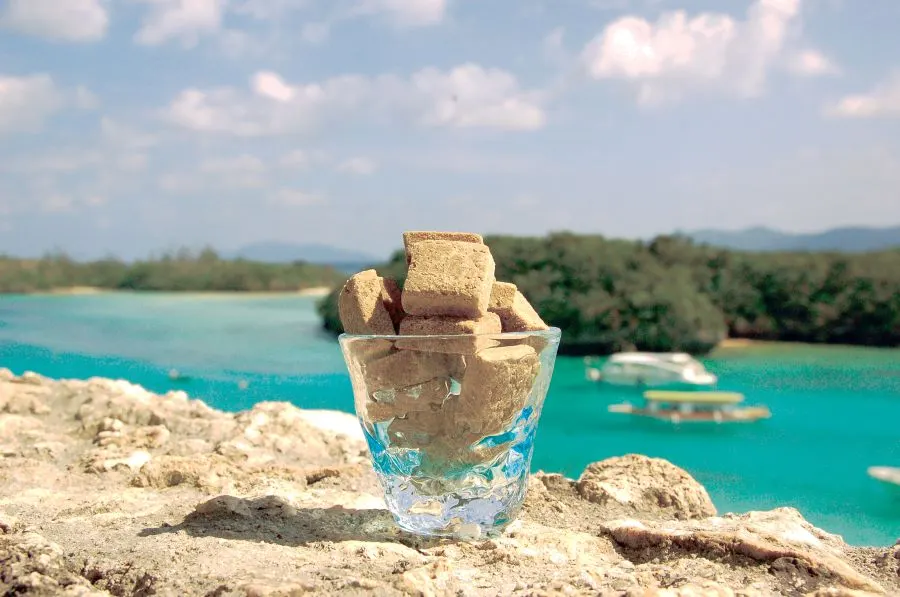
Brown sugar made the traditional way, by pressing fresh Okinawan sugarcane and boiling the juice down as is. It has a deep, distinctive flavor with a slight bitterness. Over its roughly 400-year history, it has become indispensable to Okinawan dishes and sweets such as rafute and sata andagi.
- Prefectures
- Okinawa
- Production area
- Okinawa Prefecture
- Season
- Year-round
- Registered
- November 17, 2025(Reg. No. 172)
- Registered producer group
- Okinawa Prefecture Brown Sugar Cooperative Association (opens in a new tab)
- Category (as registered)
- 第8類 調味料類第10類 パン類及び菓子類
Seasonal calendar
As a processed product, it is available year-round.
Timing shifts with the weather and conditions in each region.
Official registration details (MAFF)
The registered description as published by the Ministry of Agriculture, Forestry and Fisheries.
Characteristics
Containing components such as polyphenols, umami, and minerals, Okinawa Kokuto (Okinawa brown sugar) possesses a unique, deep flavor with a slight bitterness. With a history of about 400 years, it is widely established as an indispensable seasoning for Okinawan traditional dishes such as Rafute and traditional sweets such as Chinbin and Sata Andagi. It is also consumed daily as a tea-time snack, shaping the food culture of Okinawa.
Link with the production area
The manufacture of brown sugar began in 1623 using Okinawan sugarcane, based on sugar manufacturing methods brought back from Ming (China) by envoys of the Ryukyu Kingdom. Subsequently, brown sugar manufacturing developed as a vital industry supporting the finances of the Ryukyu Kingdom. The producers continue to use the traditional manufacturing method of pressing Okinawan sugarcane while fresh and boiling down the extracted juice as is.
Characteristics and link with the area: Ministry of Agriculture, Forestry and Fisheries website (https://www.maff.go.jp/e/policies/intel/gi_act/register/260319_2.html)
Where to buy
As a rule, only products that meet the registered standard may use a GI name (with exceptions such as prior use). Check for the GI mark and the place of origin to tell it apart from ordinary products with similar names.
These links go to Japanese-language shops; check whether they ship overseas.
Some shop links on this page are affiliate links; we may earn a commission at no extra cost to you.
Brown sugar from individual islands, such as Hateruma and Tarama, is also sold under its own name.
FAQ
Brown sugar made the traditional way, by pressing fresh Okinawan sugarcane and boiling the juice down as is. It has a deep, distinctive flavor with a slight bitterness. Over its roughly 400-year history, it has become indispensable to Okinawan dishes and sweets such as rafute and sata andagi.
Okinawa Kokuto (Brown Sugar) is produced in Okinawa Prefecture.
Okinawa Kokuto (Brown Sugar) is shipped all year round. As a processed product, it is available year-round.
Look for it via furusato nozei (hometown tax donation), online shops and the producer group's own shop. Check the GI mark and the place of origin before you buy.
Okinawa Kokuto (Brown Sugar) was registered as a Geographical Indication on November 17, 2025 (Registration No. 172). The registered producer group is Okinawa Prefecture Brown Sugar Cooperative Association.
More GIs from Okinawa
More Processed foods GIs
More from Okinawa
Discover the protected animals, festivals, paintings and sights of the same region.
Meiga no Furusato
Paintings linked to Okinawa
- Eight Views of the Ryukyu Islands: Autumn Sky at Choko
- Eight Views of the Ryukyu Islands: Evening Moon at Izumizaki
- Eight Views of the Ryukyu Islands: The Sacred Spring at Jogaku
- Pheasants in the Snow
Sake Tabi
Breweries and distilleries in Okinawa
- Helios Distillery
- Orion Happy Park (Orion Beer Nago Brewery)
- Seifuku Distillery
- Taragawa Cave Storage Tour
Official information
- MAFF registration page (Japanese) (opens in a new tab)
- MAFF product summary (English) (opens in a new tab)
- Registered product panel (PDF) (opens in a new tab)
This page is produced by Matatabi Inc. It is not created or endorsed by the Ministry of Agriculture, Forestry and Fisheries.