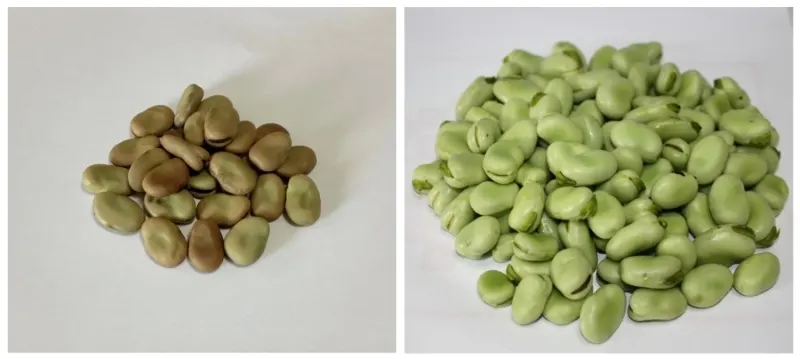
A long-pod broad bean grown around Ono in Kagawa-cho, Takamatsu, registered both as dried beans and as fresh green beans. Smaller than common Issun broad beans, with thin, soft skins, they have long been used in the local dishes oshinuki-zushi and shoyu-mame (soy sauce beans).
- Prefectures
- Kagawa
- Production area
- Ono and Terai in Kagawa-cho, and Terai-cho, Takamatsu City, Kagawa Prefecture
- Season
- May
- Registered
- January 29, 2024(Reg. No. 141)
- Registered producer group
- Ono Mame Project
- Category (as registered)
- 第1類 農産物類 穀物類(乾燥そらまめ)、野菜類(未成熟そらまめ)
Seasonal calendar
Fresh green beans are in season around May, with dried beans following later.
Timing shifts with the weather and conditions in each region.
Official registration details (MAFF)
The registered description as published by the Ministry of Agriculture, Forestry and Fisheries.
Characteristics
Compared to ordinary Issun Soramame, Ono Mame beans are characteristically small and easy to chew because they have thin and soft skin. Ono Mame beans have been valued as an ingredient in Oshinukizushi, a local dish of the area and "soy sauce beans," and since their production was revived in recent years, they have been adopted for school lunches at local elementary and junior high schools. In this context, Ono Mame is an essential vegetable in the area.
Link with the production area
The producing area is blessed with a warm climate and well-draining soil. Sanuki Nagasaya Soramame beans have long been cultivated during the off-season of rice cultivation. Since the early stage of the Showa period, the broad beans have been recognized and gained popularity as "Ono Mame". In the Heisei era, it was on the verge of extinction due to a shift in varieties, but in 2013, the local community council took the lead in reviving Ono Mame through local production for local consumption activities, collaborating with educational institutions and receiving administrative support.
Characteristics and link with the area: Ministry of Agriculture, Forestry and Fisheries website (https://www.maff.go.jp/e/policies/intel/gi_act/register/250701_7.html)
Where to buy
As a rule, only products that meet the registered standard may use a GI name (with exceptions such as prior use). Check for the GI mark and the place of origin to tell it apart from ordinary products with similar names.
We have not found a reliable online or furusato nozei listing yet. Ask local farm stands or the producer group.
Production focuses on local consumption, so it is mainly sold locally.
FAQ
A long-pod broad bean grown around Ono in Kagawa-cho, Takamatsu, registered both as dried beans and as fresh green beans. Smaller than common Issun broad beans, with thin, soft skins, they have long been used in the local dishes oshinuki-zushi and shoyu-mame (soy sauce beans).
Ono Mame (Broad Beans) is produced in Ono and Terai in Kagawa-cho, and Terai-cho, Takamatsu City, Kagawa Prefecture.
Ono Mame (Broad Beans) is in season (harvested or shipped) in May. Fresh green beans are in season around May, with dried beans following later.
We have not confirmed a reliable online or furusato nozei listing. Local farm stands or the producer group are your best bet.
Ono Mame (Broad Beans) was registered as a Geographical Indication on January 29, 2024 (Registration No. 141). The registered producer group is Ono Mame Project.
More GIs from Kagawa
More Rice, beans & soba GIs
More from Kagawa
Discover the protected animals, festivals, paintings and sights of the same region.
Official information
- MAFF registration page (Japanese) (opens in a new tab)
- MAFF product summary (English) (opens in a new tab)
- Registered product panel (PDF) (opens in a new tab)
This page is produced by Matatabi Inc. It is not created or endorsed by the Ministry of Agriculture, Forestry and Fisheries.