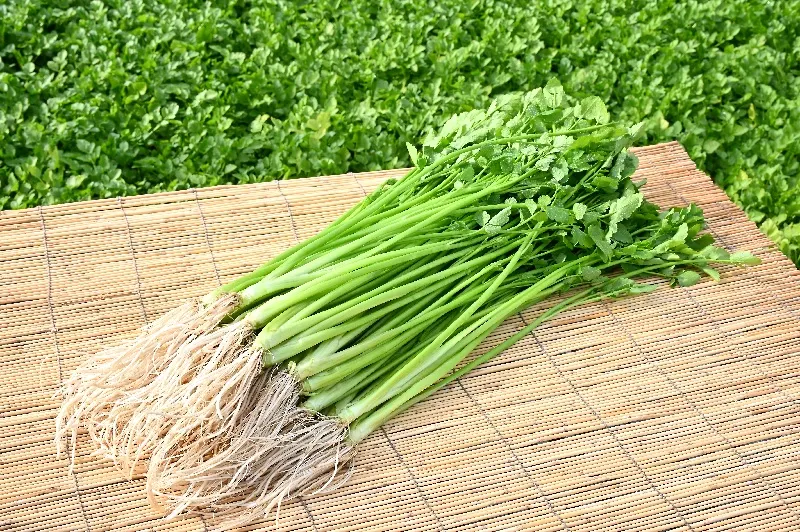
Water dropwort grown in Natori and Sendai's Taihaku Ward, Miyagi, using abundant subsoil water from the Natori River. Its bright green leaves and stems contrast beautifully with its white roots, and it has a fresh aroma and crisp bite. Seri nabe, a hot pot that uses the whole plant including the roots, has become a Sendai specialty.
- Prefectures
- Miyagi
- Production area
- Former Masuda Town in Natori City, and Taihaku Ward, Sendai City, Miyagi Prefecture
- Season
- Sep–Jun
- Registered
- March 27, 2024(Reg. No. 149)
- Registered producer group
- Sendai Seri Shinko Kyogikai (Sendai Dropwort Promotion Association)
- Category (as registered)
- 第1類 農産物類 野菜類(せり)
Seasonal calendar
Rooted ne-seri is available from September to March and young ha-seri from April to June; seri nabe is at its best in winter.
Timing shifts with the weather and conditions in each region.
Official registration details (MAFF)
The registered description as published by the Ministry of Agriculture, Forestry and Fisheries.
Characteristics
It has a beautiful contrast between vivid green leaves, shoots and white roots, with its fresh fragrance, rich taste, and crispy texture. The dropwort is used for regional cuisine and dishes for traditional events and has been anchored as an essential traditional ingredient for regional customs and food culture.
Link with the production area
Sendai Dropwort cultivation is believed to have started during the Edo period when people improved and cultivated water dropwort that grew naturally in wetlands created by subsoil water from the Natori River. Using a variety that has long been selected and bred, producers have cultivated Sendai Dropwort using abundant subsoil water and implemented strict shipment control. In addition to a dropwort appeared in a haiku poem composed by Date Masamune, the area has long been famous nationwide as a production area for dropwort, which has been used in traditional dishes such as Sendai zoni, as well as everyday dishes. In recent years, "seri nabe", in which the entire plant is eaten, including the roots, has become a specialty of Sendai.
Characteristics and link with the area: Ministry of Agriculture, Forestry and Fisheries website (https://www.maff.go.jp/e/policies/intel/gi_act/register/250701.html)
Where to buy
As a rule, only products that meet the registered standard may use a GI name (with exceptions such as prior use). Check for the GI mark and the place of origin to tell it apart from ordinary products with similar names.
These links go to Japanese-language shops; check whether they ship overseas.
Some shop links on this page are affiliate links; we may earn a commission at no extra cost to you.
FAQ
Water dropwort grown in Natori and Sendai's Taihaku Ward, Miyagi, using abundant subsoil water from the Natori River. Its bright green leaves and stems contrast beautifully with its white roots, and it has a fresh aroma and crisp bite. Seri nabe, a hot pot that uses the whole plant including the roots, has become a Sendai specialty.
Sendai Seri (Water Dropwort) is produced in Former Masuda Town in Natori City, and Taihaku Ward, Sendai City, Miyagi Prefecture.
Sendai Seri (Water Dropwort) is in season (harvested or shipped) in Sep–Jun. Rooted ne-seri is available from September to March and young ha-seri from April to June; seri nabe is at its best in winter.
Look for it via furusato nozei (hometown tax donation) and online shops. Check the GI mark and the place of origin before you buy.
Sendai Seri (Water Dropwort) was registered as a Geographical Indication on March 27, 2024 (Registration No. 149). The registered producer group is Sendai Seri Shinko Kyogikai (Sendai Dropwort Promotion Association).
More GIs from Miyagi
More Vegetables GIs
More from Miyagi
Discover the protected animals, festivals, paintings and sights of the same region.
Official information
- MAFF registration page (Japanese) (opens in a new tab)
- MAFF product summary (English) (opens in a new tab)
- Registered product panel (PDF) (opens in a new tab)
This page is produced by Matatabi Inc. It is not created or endorsed by the Ministry of Agriculture, Forestry and Fisheries.